Why Train Here
What Makes Sitar Here Different
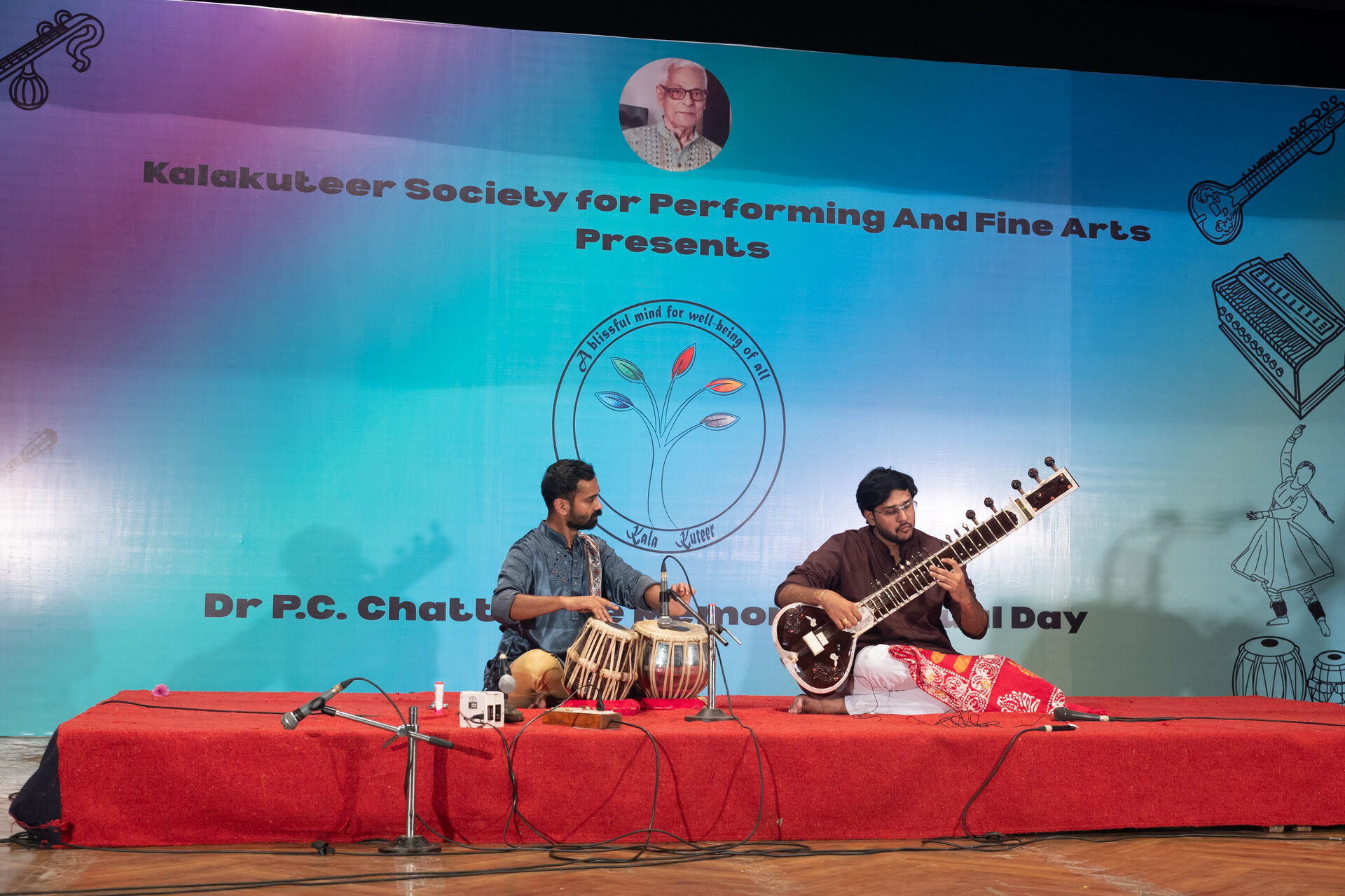
Live Tabla, Not Just Recordings
You play to a living pulse, never a metronome. A tabla player answers your phrasing in the room — a true जुगलबंदी, the call-and-response that has always been the heart of our music. Sangeet means 'together in song'; we take that literally. It is something most schools simply cannot offer.
A Real Raga Education
This is not film-tune sitar. You learn the full architecture of a raga — alap, jor, jhala, gat — the slow unfolding the old masters called a lifetime's work. We begin it with you from the very first lesson.
Original Compositions, Not the Usual Few
Our gurus compose original pieces for their students. You won't only repeat the handful of bandishes every other sitar student in the city already knows — you will learn music born in this gurukul.
From 10 to 70, In Person or Online
Our youngest sitarist is ten, our oldest is seventy — proof that the right time to begin is the moment you decide to. In Hyderabad in person, or live online, anywhere in the world.
Legend credits Amir Khusrau with the sitar — सेह-तार, 'three strings' — some seven centuries ago. Whether or not the tale is true, the instrument has been singing ever since: a single string that can slide between two notes and find a hundred unnamed feelings in between.
That sliding voice — the meend — is the soul of Hindustani music, and it cannot be hurried. At Kala Kuteer the sitar is taught patiently, note by note, until the wire stops feeling like metal and begins to feel like breath.
सब्र का फल मीठा होता है
Sabr ka phal meetha hota hai \u2014 The fruit of patience is sweet.
What You'll Learn
Foundations
Holding the Sitar, the mizrab (plectrum), right-hand technique, and your first clear notes and sur.
Raga & Technique
Meend (glides), tone, and the language of a raga — the heart of what makes the Sitar sing.
The Full Performance
Alap, jor, jhala, and gat — the complete architecture of a raga.
Performance & Exams
Stage performance and preparation for ABGMM graded examinations.
नाद ब्रह्म
“Sound itself is the Divine. The seers heard the whole of creation in a single, sounding note — and on the sitar, you spend a lifetime in search of it.”
— the Vedic ideal of Naada Brahma
In Person & Online
Learn in person at our Tarnaka and Gachibowli branches in Hyderabad, or live online via Zoom from anywhere in the world — the same gurus and curriculum, with real personal attention.
See It Performed
Frequently Asked
Do I need any prior experience to learn the Sitar?+
None at all. We start from the very beginning — how to hold the instrument, the mizrab, and your first clear notes — and build patiently from there.
What age can I start learning Sitar?+
Almost any age. Our youngest Sitar student is 10 and our oldest is 70 — children begin once their hands are comfortable on the instrument, and adults are very welcome to start at any stage of life.
Is the Sitar taught in the Indian classical tradition?+
Yes — Sitar at Kala Kuteer is rooted in Hindustani classical music: ragas, taals, and the full arc of a raga performance, from alap to jhala.
Can I learn Sitar online?+
Yes. We teach Sitar live over Zoom to students around the world, with the same gurus and curriculum as our in-person classes.
Are there exams or certifications?+
Yes — students can prepare for the graded examinations of the Akhil Bharatiya Gandharva Mahavidyalaya (ABGMM).
Take It Further
Train to Teach
For students who want to make the arts a career, Kala Kuteer offers a specialised Teacher Training Program — learn not just Sitar, but how to teach it.
Begin Your Sitar Journey
Reach out on WhatsApp — we'll understand where you are and set up a conversation with the right guru.
Enquire on WhatsApp